


How Much Should a Service-Based Business Spend on Marketing?
If you’ve ever searched “how much should I spend on marketing,” you’ve probably found a range so wide that it is not very helpful. Depending on the source, the answer could be anywhere from 2% to 20% of revenue.
The truth is, your marketing budget is not a fixed number. It is a strategic decision based on your goals, market, competition, and current stage of growth. Spend too little, and you risk being invisible. Spend in the wrong places, and you can burn through your budget without seeing meaningful results.
So, what should a service-based business actually spend on marketing?
Let’s look at the data, what those numbers mean for your business, and how to build a budget around real growth goals instead of guesswork.
What Are Businesses Actually Spending on Marketing?
Current research gives us a useful starting point.
Gartner’s 2025 CMO Spend Survey found that average marketing budgets held at 7.7% of company revenue. The Deloitte and Duke CMO Survey puts marketing investment slightly higher at 9.4%, particularly among B2B companies.
The U.S. Small Business Administration recommends that businesses with less than $5 million in annual revenue allocate roughly 7% to 8% of gross revenue to marketing.
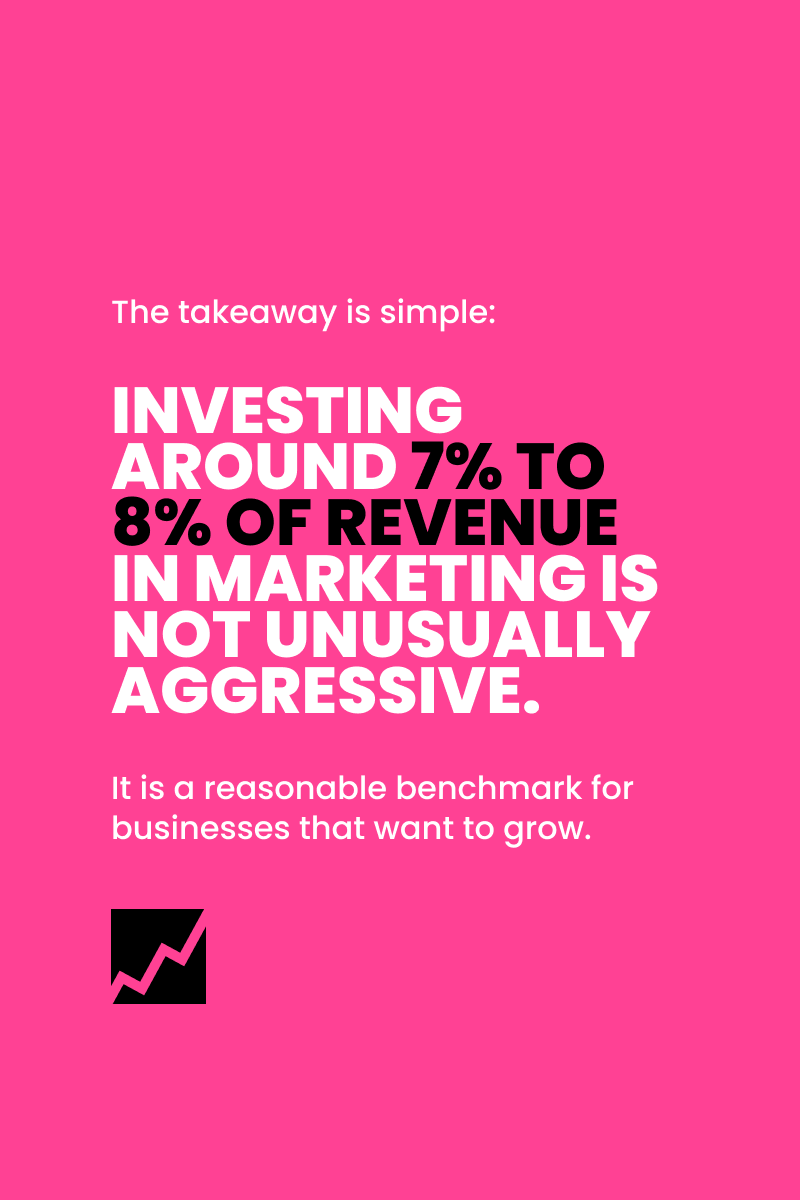
The takeaway is simple: investing around 7% to 8% of revenue in marketing is not unusually aggressive. It is a reasonable benchmark for businesses that want to grow.
That does not mean every company should immediately set its budget at 8%. Your goals should determine your investment.
Match Your Marketing Budget to Your Growth Goals
A business focused on maintaining its current customer base should not have the same marketing budget as one trying to enter a new market.
Here is a practical way to think about it.
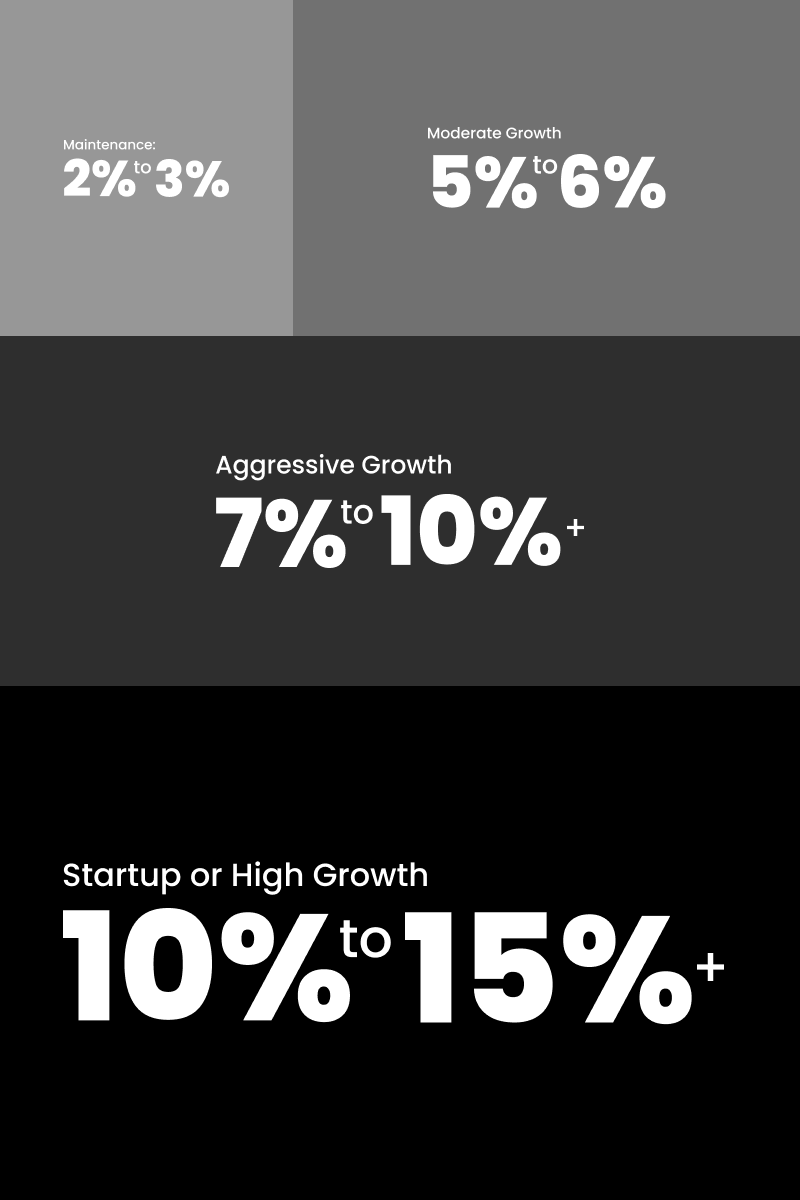
Maintenance: 2% to 3%
This level may work if your pipeline is already full, referrals consistently generate business, and aggressive growth is not currently a priority.
For a company generating $1 million in annual revenue, that means investing approximately $20,000 to $30,000 per year.
At this level, you may be able to maintain your website, social presence, and a limited advertising strategy, but there is not much room for expansion or experimentation.
Moderate Growth: 5% to 6%
Businesses looking for steady growth may need to invest closer to 5% or 6%.
A $1 million business investing 5% would have a $50,000 annual marketing budget.
That gives you more room for a multi-channel strategy that could include SEO, content creation, email marketing, social media, and paid advertising.
This level can make sense if you are looking to grow steadily, add a new service, or expand your visibility without pursuing aggressive market share.
Aggressive Growth: 7% to 10%+
Businesses pursuing significant growth should expect marketing to require a larger investment.
This is especially relevant if you are:
- Entering a new geographic market
- Competing in a crowded industry
- Building brand recognition
- Trying to increase lead volume
- Reducing your reliance on referrals
- Launching a major new service
At 8%, a $1 million company would invest $80,000 annually. That creates room for a much more complete marketing strategy across paid advertising, SEO, content, email, social media, and brand development.
Startup or High Growth: 10% to 15%+
New businesses face a different challenge. People cannot choose a company they do not know exists.
Building awareness from the ground up often requires heavier marketing investment before revenue catches up. Companies entering aggressive growth phases may face the same situation.
In these cases, an investment of 10% to 15% or more may be appropriate.
Service Businesses Have to Market Trust
Service-based businesses face a unique marketing challenge.
Customers cannot hold your service in their hands before buying it. They are evaluating your expertise, reputation, communication, process, and credibility.
Your marketing has to build that trust before your sales team ever has a conversation with the prospect.
That means your website matters. Reviews matter. Photography matters. Search visibility matters. Social proof matters. Consistent communication matters.
Marketing is not simply about getting your name in front of more people. It is about giving the right people enough confidence to take the next step.
Marketing Is Getting More Expensive
Budgeting based on what you spent three years ago can create a problem.
WordStream’s 2025 benchmarks put the average Google Ads cost per lead at $70.11, an increase of more than 5% year over year. Meta lead costs also increased significantly in 2025.
If advertising costs increase while your marketing budget stays flat, your buying power decreases.
The solution is not simply to spend more. Better strategy matters just as much.
WordStream also found that Google Ads conversion rates improved 6.84% year over year in 2025. Better campaigns, landing pages, messaging, targeting, and optimization can help offset higher acquisition costs.
That is why marketing budget conversations should never focus exclusively on dollars. How effectively those dollars are being used matters just as much.
Should You Cut Marketing When Business Slows Down?
Cutting marketing can feel like an easy way to reduce expenses during uncertain periods. The long-term impact deserves consideration.
Analytic Partners found that brands increasing advertising investment during previous downturns achieved an average 17% higher ROI than competitors that reduced spending.
Research cited from Peter Field and the B2B Institute also found stronger long-term business effects among companies that maintained marketing investment.
There is a practical reason for this.
When competitors become quieter, staying visible becomes more valuable.
Reducing ineffective spending is smart. Eliminating marketing simply because conditions are uncertain can create a visibility problem that becomes much harder to fix later.
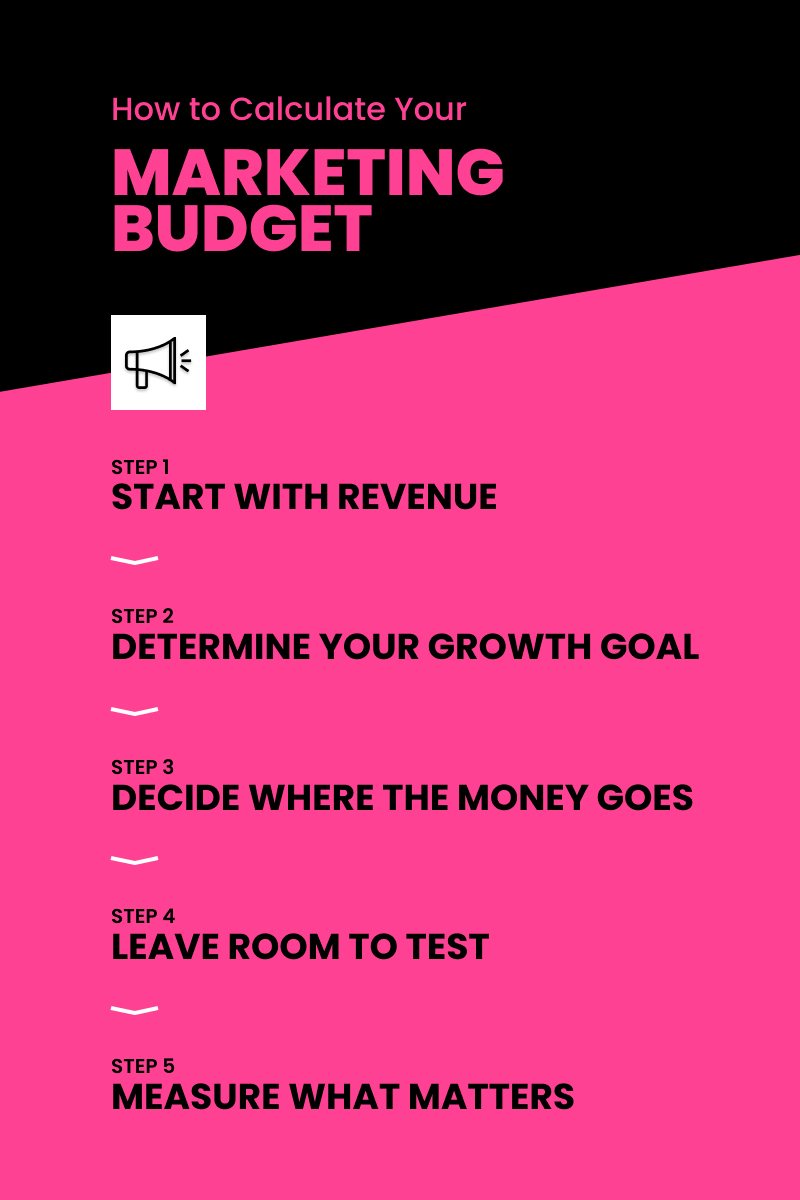
How to Calculate Your Marketing Budget
You do not need to make this overly complicated.
Step 1: Start With Revenue
Use your actual or projected annual revenue as your baseline.
Step 2: Determine Your Growth Goal
Choose the investment range that most closely matches what you are trying to accomplish:
Growth Goal
Marketing Investment
Maintenance
2% to 3%
Moderate Growth
5% to 6%
Aggressive Growth
7% to 10%
Startup or High Growth
10% to 15%+
Step 3: Decide Where the Money Goes
Your total budget is only the beginning.
A service-based business might invest across paid advertising, SEO, website improvements, social media, email marketing, photography, video, content creation, events, and marketing technology.
The right mix depends on where your customers spend their time and how they make buying decisions.
A contractor targeting homeowners through Google needs a different channel mix than a B2B professional service company with a six-month sales cycle.
Your budget should reflect your actual customer journey.
Step 4: Leave Room to Test
Marketing rarely works perfectly on the first attempt.
Consider reserving 10% to 15% of your marketing budget for testing new campaigns, creative, messaging, audiences, or channels.
Testing gives you room to learn instead of locking every dollar into assumptions made at the beginning of the year.
Step 5: Measure What Matters
Review performance regularly and ask:
- What is our cost per lead?
- What is our customer acquisition cost?
- Which channels generate qualified opportunities?
- How many leads become customers?
- How much revenue can we attribute to marketing?
- Which investments are supporting long-term visibility?
A channel generating hundreds of clicks but no qualified leads is not necessarily outperforming one that produces fewer, better opportunities.
Measure the outcomes that matter to the business, not just the numbers that look good in a report.
So, How Much Should You Spend?
For many established service-based businesses, 7% to 8% of gross revenue is a useful benchmark for meaningful growth.
Your actual number may be higher or lower.
A company with strong organic visibility, an established brand, and a steady referral pipeline may not need the same percentage as a business entering a new market. A company that wants to double in size should not expect to invest at maintenance levels.
Start with the outcome you want, then work backward.
What does growth look like this year? How many new customers will you need? How many qualified leads will it take to generate those customers? Which marketing channels can realistically create those opportunities?
Those questions will tell you much more than an arbitrary percentage ever could.
Build a Budget That Has a Job to Do
Your marketing budget should not simply be an expense you try to keep as low as possible. Every dollar should have a purpose tied to a larger business goal.
The businesses that get the most from marketing are not necessarily the ones spending the most. They are the ones investing intentionally, tracking what matters, and adjusting based on what the data tells them.
At Fierce Creative Solutions, we help service-based businesses build marketing strategies around their goals, audience, and growth plans. If you are not sure what you should be spending or where your marketing dollars should go, we can help you build a clearer plan.