


Why Most Service Business Ads Fail (And What Actually Makes Google & Facebook Ads Work)
Running ads is not about spending money.
It’s about investing money with a clear purpose.
That sounds obvious, but most service businesses skip straight to launching campaigns before they’ve answered the questions that actually determine whether ads work in the first place.
So what happens?
They boost random posts.
Launch Google Ads with broad targeting.
Send traffic to their homepage.
Burn through budget.
Then decide “ads don’t work.”
The problem usually isn’t the platform.

At Fierce, we’ve seen the same patterns repeat across roofing companies, builders, outdoor living brands, home service businesses, and local contractors:
- No clear goal
- Wrong platform
- Weak offer
- Poor targeting
- Bad landing pages
- No optimization process
And all of those problems lead to the same thing:
Wasted ad spend.
The Biggest Misunderstanding About Digital Ads
Most business owners ask:
“Which platform works best?”
That’s the wrong question.
The better question is:
“Where is my customer in their decision process?”
Because every platform does a different job.
Google Ads Capture Demand
Google Ads are intent-based.
People are actively searching for a solution.
That’s why Google works especially well for:
- Roofing companies
- Remodelers
- HVAC
- Home services
- Contractors
- Local service businesses
The customer already has intent.
Your job is to show up when they search.
That’s demand capture.
And when campaigns are structured correctly, the results compound quickly.
One of our contractor campaigns went from:
- 17 conversions in October
- to 129+ conversions by January
while lowering CPL from $31.76 to $10.57.
Why?
Not because we “hacked the algorithm.”
Because we fixed the fundamentals:
- Exact and phrase match keywords
- Negative keyword lists
- Better conversion tracking
- Dedicated PPC landing pages
- Consistent optimization
That’s what actually improves performance over time.
Meta Ads Create Demand
Facebook and Instagram work differently.
People are not actively searching.
You’re interrupting attention.
That means Meta works best for:
- Brand awareness
- Retargeting
- Visual industries
- Outdoor living
- Home upgrades
- Lifestyle-focused services
Meta is not just a lead platform.
It’s a visibility platform.
And visibility matters because familiarity shortens the sales process.
One e-bike campaign we managed saw:
- Content views jump from 343 to 1,006
- Adds-to-cart increase from 75 to 443
- Cost-per-content-view drop from $1.32 to $0.37
The biggest change?
Updated creative.
Not a bigger budget.
Not a magic audience.
Not a “secret strategy.”
Better creative.
That’s it.
Most Ads Fail Before They Ever Launch
Businesses love obsessing over targeting.
But targeting is only part of the equation.
Most campaigns fail because the offer is weak.
There’s no urgency.
No clear outcome.
No compelling reason to act.
Compare these two offers:
❌ “Contact us for a quote.”
vs.
✅ “Get a Free 3D Deck Design This Week.”
One is generic.
One gives the customer a reason to move now.
That difference matters.
Your ad usually isn’t the problem.
Your offer is.

Cold Audiences and Warm Audiences Should Never See the Same Ad
This is where a lot of businesses waste money.
Cold audiences do not know you yet.
Warm audiences already do.
Those require completely different messaging.
Cold Audiences Need Education
Your goal is awareness.
This audience responds to:
- Problem-focused messaging
- Educational content
- Before-and-after visuals
- Helpful information
Examples:
- “Here’s what to know before replacing your roof.”
- “5 signs your deck needs replaced.”
Warm Audiences Need Trust + Action
Your goal is conversion.
This audience responds to:
- Testimonials
- Offers
- Urgency
- Social proof
- Retargeting
Simple framework:
Cold audiences = educate.
Warm audiences = convert.
Most businesses skip the education stage and immediately try to sell strangers.
That’s why performance stalls.
Your Creative Matters More Than You Think
Most service business ads fail in under 3 seconds.
Not because the service is bad.
Because the message is unclear.
Here’s what actually works right now:
Real > Perfect
Real projects.
Real employees.
Real customers.
Stock photos get ignored.
Clarity > Cleverness
Say exactly what you do.
People should immediately understand:
- who you help
- what problem you solve
- what the next step is
Outcomes > Features
Nobody buys “metal roofing panels.”
They buy:
- lower maintenance
- durability
- protection
- curb appeal
- peace of mind
If people don’t understand your ad instantly, they scroll.
Most Businesses Lose Money After the Click
This is the part almost nobody talks about.
Getting the click is only half the job.
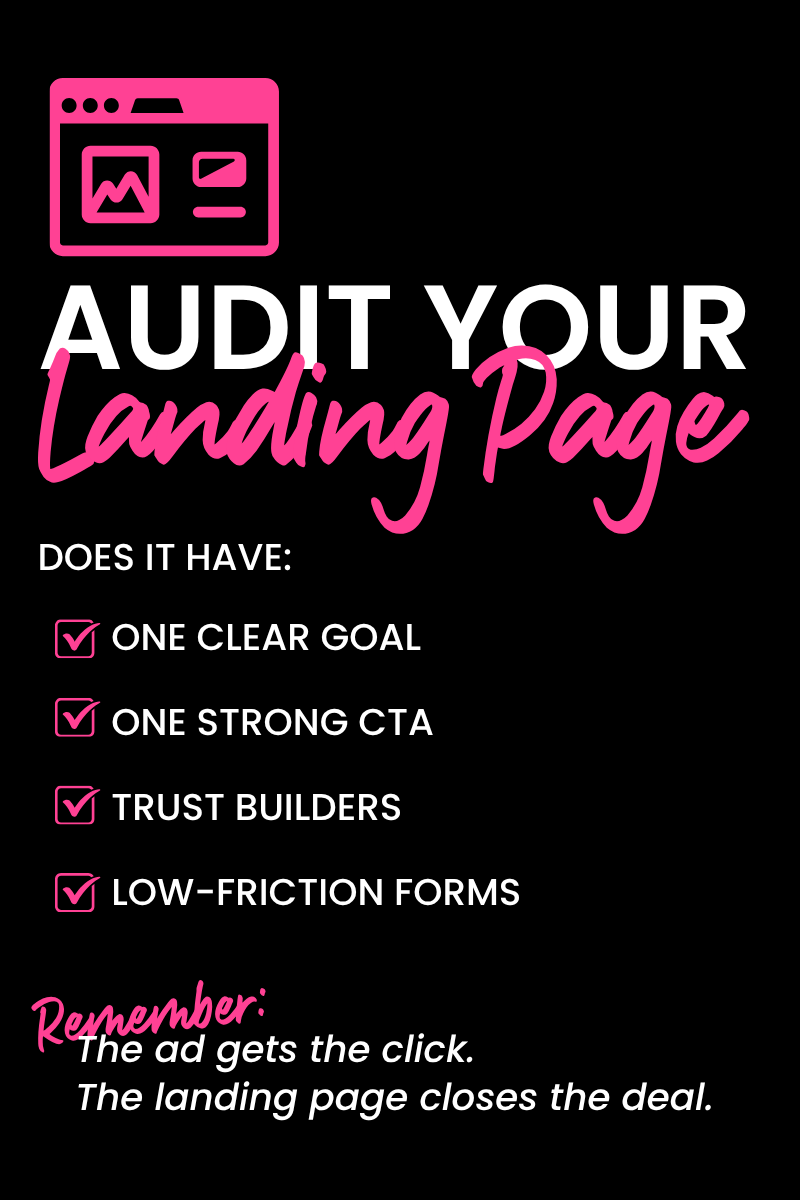
The landing page closes the deal.
And most service businesses are sending paid traffic to:
- cluttered homepages
- generic service pages
- disconnected website experiences
That kills conversion rates.
One contractor campaign we managed jumped from:
- 38 conversions at $91 CPL
to: - 117 conversions at $53 CPL
after:
- launching a new website
- improving conversion tracking
- segmenting campaigns better
- building dedicated landing pages
The ads were not the issue.
The system around the ads was.
What a High-Converting Landing Page Actually Needs
The highest-converting landing pages are usually simple.
Not flashy.
Not complicated.
Simple.
They need:
- One clear goal
- One strong CTA
- Trust builders
- Message match with the ad
- Low friction forms
- Clear outcomes
That’s it.
The formula is simple:
Ad → Landing Page → Conversion
If one piece breaks, the whole system struggles.
The Metrics That Actually Matter
A lot of businesses focus on vanity metrics because they’re easy to look at.
Likes.
Reach.
Impressions.
Those are not the metrics paying your bills.
The metrics that actually matter are:
- CTR (Click-through-rate)
- CPC (Cost per click)
- Conversion rate
- CPL (Cost per lead)
- Lead quality
- Close rate
And more importantly:
What are the numbers telling you?
Low CTR?
Usually a messaging problem.
High CPC?
Targeting or competition issue.
High traffic but low conversions?
Landing page problem.
Good marketers don’t just read numbers.
They interpret them.
Optimization Is Where Great Campaigns Are Built
Optimization is where performance actually happens.
The best-performing campaigns are rarely perfect out of the gate.
They improve because someone is paying attention consistently.
That means:
- Reviewing search terms
- Removing wasted spend
- Testing creative
- Improving landing pages
- Refining offers
- Monitoring conversion quality
- Adjusting budgets intentionally
One home service campaign improved from:
- $114 CPL
to: - $72 CPL
simply by:
- cleaning up keyword targeting
- fixing negative keywords
- improving ad copy
- correcting conversion tracking
Small improvements compound.
That’s the difference between running ads and managing ads strategically.
Ads Are Not Magic. They’re a System.
The businesses getting the best results from digital advertising are not guessing.
They’re building systems.
Systems that:
- create visibility
- capture demand
- reinforce trust
- improve over time
Because successful ads are not built on hacks.
They’re built on:
- clarity
- consistency
- strategy
- optimization
Stop guessing.
Start running ads with intention.
Want Better Results From Your Ads?
At Fierce Creative Solutions, we help service businesses build ad systems that actually support long-term growth — not just random spikes in leads.
Because the goal isn’t just getting clicks.
It’s building a marketing system that turns attention into real business growth.